More ideas than the usual way can deliver.
Survey of 307 CIOs, CTOs and CISOs: Wynter for Retool, June 2026.
Development has to get several times faster.
AI already writes code. To make projects noticeably faster and cheaper, the process itself has to change.
Testing an idea is easy, but each new change can break what already worked, and no one maintains the system or owns the risks.
The process stays the same. Some tasks get faster, others slower, and the project as a whole does not speed up. And token costs grow with the code.
The application is defined by a model, which is easier to change than thousands of lines of code. Changes ship faster and cost less, and each one passes the platform's checks.
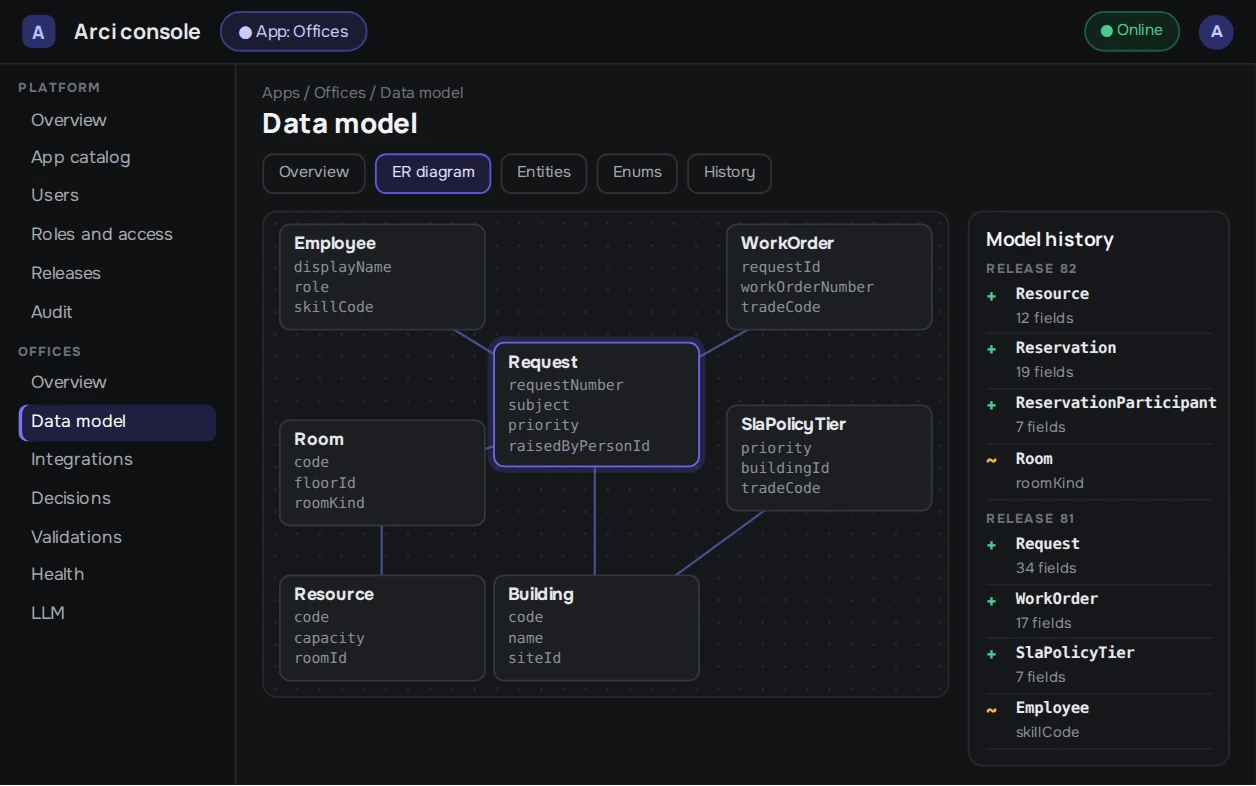
Offices case: 12 weeks, 57 entities, 24 screens, 9 workplacesAgents carry out multi-step tasks directly in code and are strongest in complex systems. They need a mature engineering environment, built by engineers.
Data on the effect of AI assistants: GitHub, 2023 — +55.8% on a lab task; Google, 2024 — about 21%; METR, 2025 — experienced developers were 19% slower on their own tasks.
With Arci, the business gets vibe-coding speed,
and IT keeps control over security, audit and support.
A small team decides what comes first and owns the result. Each product has its own team, and teams work in parallel.
Permissions, audit, checks and releases are the same in every application. IT is responsible for the security and operation of the platform and evolves the systems that need code.
From idea to production.
The team and AI agents describe the application as a model, and the platform runs it. Every change follows the same path: model, checks, release.
- 01IdeaProduct owner
Defines what the business needs and how to check the result.
- 02Business requirementsAnalyst
Describes the process: participants, rules, links to systems.
- 03ModellingAnalyst and AI agents
AI agents turn the description into the application model, and the platform checks it.
- 04ExecutionPlatform
The model runs on the platform.
A change edits the description, not the code.
Example: add a “Priority” field to a request and show it to the dispatcher.
Agent writes code
- RequestForm.tsx
- QueueTable.tsx
- requests.api.ts
- policies.ts
- 0042_priority.sql
Five files across different layers. The whole app needs re-testing.
Arci
request:fields: number, address, descriptionpriority:values: P1, P2, P3, P4required: for incidentsvisible to: dispatcherThe core itself checks permissions, the database and screens, and writes the audit log.
Engineering culture built into the platform.
Arci checks every change, and the team works on the business task itself.
Control lives in the core, not in the agent.
Checks are automated and do not depend on agent errors: build and release go through a core the agent cannot reach. A broken rule blocks the change or lands in the audit log.
On your sideyour team, AI agents and your infrastructure
Arci coreindependent of the agent and its environment
Your environment · your infrastructure
AI agentsClaude, Codex, Cursor and others
task → plan → change → self-checkAI models: cloud or local
Provided by Arci · runs in your environment
- Rulesrecipes, platform rules, prohibitions and policies, in the agent's context
- Checksmodel checks against the canon (permissions and roles, versions, references) and a screen linter, which the agent runs on every edit
- Agent managementeach agent has its own task, permissions and limits; a shared board
- Built on a pinned platform release
- A linter based on Arci rules, and unit tests
- Code analysis and screen checks
- Failed: the change goes back to the agent
- The built and checked release goes to the test environment
- Readiness check after start
- Release audit: what was released, where and when
- Any previous release can be deployed again
- An error stops the build.
At the very first build step the application model is checked against the platform's rules. If the model has an error, the build stops at once and shows the agent where it is.
- The change shows up in the test environment.
You see how the application has actually changed, and any inaccuracy in the model shows up at once.
- AI agents connect on the platform's terms.
An application publishes its processes as MCP tools: external agents can call only what is published, and every call is audited. AI models are called through the platform's AI gateway.
The engineering part of the application is provided by the platform.
This is how a request travels through the application. In every part the team writes only the description. The platform does the rest.
- Description — written by the team and AI agents
- Platform — ready-made code shared by all applications
- Outside — stays as it is
Roles and permissionsSign-in and usersPermission check on every requestPersonal data maskingAudit and logSettings and feature flagsInterface languagesSystem passport
Build and releaseCluster and scalingMonitoring and logs
StackJava 25Spring Boot 4Apache CamelOAuth2 / OIDCOpenTelemetryMCPAndroidiOS
Outside
Links to the outside world
Interface User
API Partners
MCP AI agents
Integrations Your systems
AI gateway AI models
Logic and data
Business logic
Data Database
Roles and permissionsSign-in and usersPermission check on every requestPersonal data maskingAudit and logSettings and feature flagsInterface languagesSystem passport
Build and releaseCluster and scalingMonitoring and logs
StackJava 25Spring Boot 4Apache CamelOAuth2 / OIDCOpenTelemetryMCPAndroidiOS
Where code is needed
- IntegrationsComplex adapters.
Standard adapters and mapping are configured in Arci. Only the most complex ones are written in code.
- Business logicComplex logic.
Heavy calculations and special logic are written in code, and the Arci application calls them through integrations.
- Your systemsEvolving your systems.
Arci works with the core system, processing, CRM and scoring through integrations, while the systems themselves evolve in code.
With Arci the team learns agentic development and applies that experience to tasks that need code.
Where Arci fits.
From a single task to the entire front office.
- MVPs and hypotheses
If the idea works, the same MVP grows into a production system, and the work carries on from where it is.
- Digitising routine work
Requests, registers, approvals and reconciliations move from Excel and email into convenient applications.
- Step-by-step modernisation
Functions move from the core system, ERP or CRM to Arci one at a time. The old system keeps running, while new capabilities appear on Arci.
- Unified front-office system
Web, mobile app, self-service kiosk and bot all run on one model. With conventional development, this is a multi-year programme.
People and timelines by the scale of the task.
Indicative estimate for typical tasks
Dozens of users, one or two integrations.
Hundreds of users, mandatory audit.
Dozens of connected systems, roles and access, multi-step approvals.
Processing, billing, settlement and trading systems: millions of operations and strict speed requirements.
In agentic development, AI agents write the code under engineers' control. Such systems run alongside, and Arci connects to them through integrations.
part-timefaded — upper end of the estimate
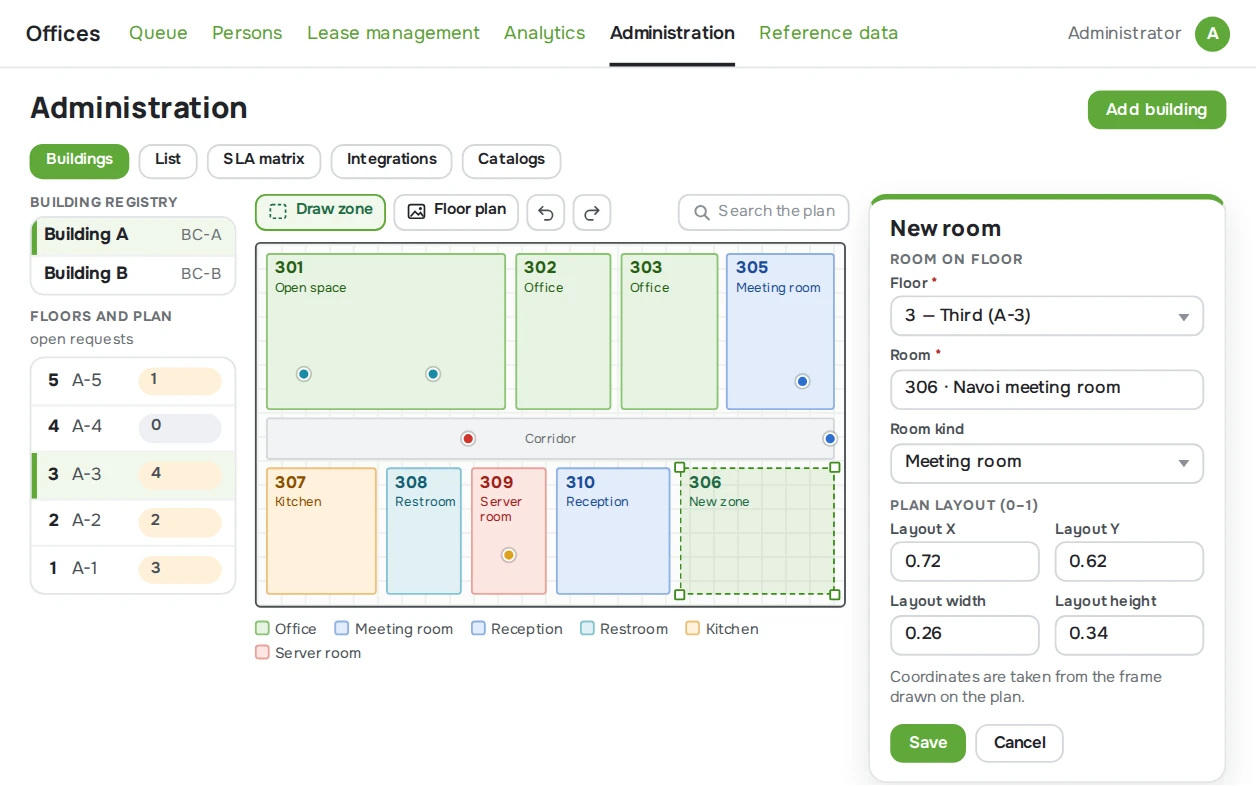
An office management system.
An application for offices and business centres: requests from the portal and Telegram, work orders, planned maintenance, stock, passes and meeting rooms. The data model is visible in the Arci console.
- 12
- weeks of development
- 9
- workplaces, from the request portal to management
- 57
- entities in the model
- 24
- screens
Start with one process.
Pick a task you have long wanted to solve. Your team builds it, while we train the team and take care of the platform.
Pilot plan
What we need from you
A process owner and an analyst. An administrator and a security specialist will be needed for a few days.
What we provide
The platform, team training and second- and third-line support for the whole pilot.